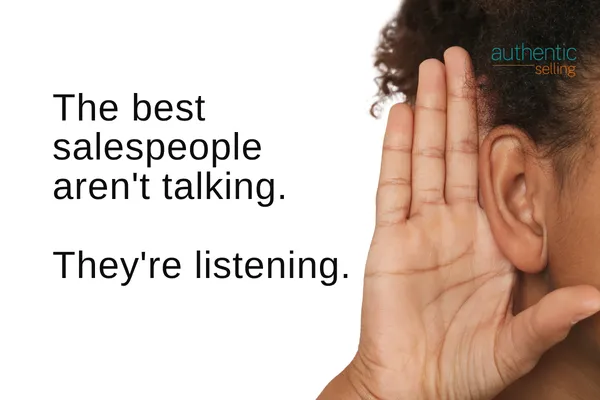
The Best Salespeople Aren't Talking. They're Listening.
Anyone who knows my work will know how much I go on about the power of using questions when selling. So, you’ll understand why I loved this latest podcast from Simon Sinek.
Simon Sinek’s A Bit of Optimism is currently running a five-part series on human skills, the things that help us connect, collaborate and work well together. During a recent episode, Simon and his guest, Alex Simon, dug into the art of listening: what gets in the way of it, and what it actually takes to make someone feel heard.
At one point their conversation turned to how important being a good listener is when selling. My ears pricked up.
Simon shared a stat from sales coach Jack Daly:
“There’s a famous sales coach named Jack Daly who told me that the average bad sales call, the salesperson will ask seven questions, and the average good sales call, the salesperson will ask 32 questions on average.”
This is not surprise to me. It was great to hear some real numbers behind what all good salespeople know to be true.
That’s the difference between a conversation and a monologue.
As Simon says:
“The best salespeople are much quieter, and they use their ears a lot more.”
The myth of the ‘good talker’
Many people assume good salespeople are good talkers. That they have ‘the gift of the gab’. The smooth ones. The ones who always seem to have the right thing to say. But that’s actually backwards.
The best salespeople listen more than they talk. They are focused on understanding what their customer needs and working with their customer to deliver it.
Humanness is more important than ever
Understanding how humans work, and how to have conversations is more important than ever.
With everyone consumed by automation and AI right now, it’s important to remember that buyers are still human.
Humans want to feel understood, not processed.
Someone talking at you doesn’t make someone feel understood. A genuine question does.
Lead with Curiosity
Simon’s thoughts also line up with an approach I love:
Lead with curiosity.
If you are genuinely curious and interested in the other person’s business, not only do people want to connect with you – life is more interesting!
I like to ask questions that help the buyer think differently about their own problem. Then you can get into a really good discussion, and work together in a genuine way to find a solution.
Lets face it: being curious makes the world much more interesting and enjoyable. Why not enjoy the process, and learn a little along the way?
What this looks like in practice
Rather than thinking about what you need to say on your next sales call, think about what questions you need to ask. If Jack Daly’s stat is anything to go by, most of us have a way to go to 32 questions in a meeting. So when in doubt: ask a question.
Follow up on what you hear. It’s really less about the number of questions and more about listening to the answer, checking that you actually understand, and then letting that lead you to the next logical step in the conversation.
Get comfortable with silence. Let someone finish a thought instead of jumping in with your next line.
The takeaway
Good selling was never about having the best answers. It’s about asking the right questions, then actually listening to what comes back. That’s not a soft skill bolted onto sales. It is sales.
In the words of Simon Sinek:
“When we say sales, we should stop calling it sales and we should start calling it listening.”
Want to learn more about selling as a human?
Join me for my free webinar, Selling B2B without AI Sales Slop, Wed 5th August.