Where Marketing and Sales Meet
Where AI Helps, and Where You Lead
A lot of founders think of marketing and sales as two separate jobs. Marketing brings in the leads, sales closes them, and there's a neat handover somewhere in the middle.
In reality it's not that tidy. The best businesses have marketing and sales working together at every stage of the customer's journey, passing the baton back and forth and each doing what they're best at. Where that baton gets passed depends a lot on the size of the sale.
Now that AI is part of the picture, it's worth asking where it fits too. Some parts of the journey work well with automation. Other parts need a human to lead.
Let's look at how it all fits together.
The journey your customer goes on
I love the customer journey funnel created by Racquel Collard from Navitential. It maps how a customer moves from "never heard of you" to "buying from you again and again":
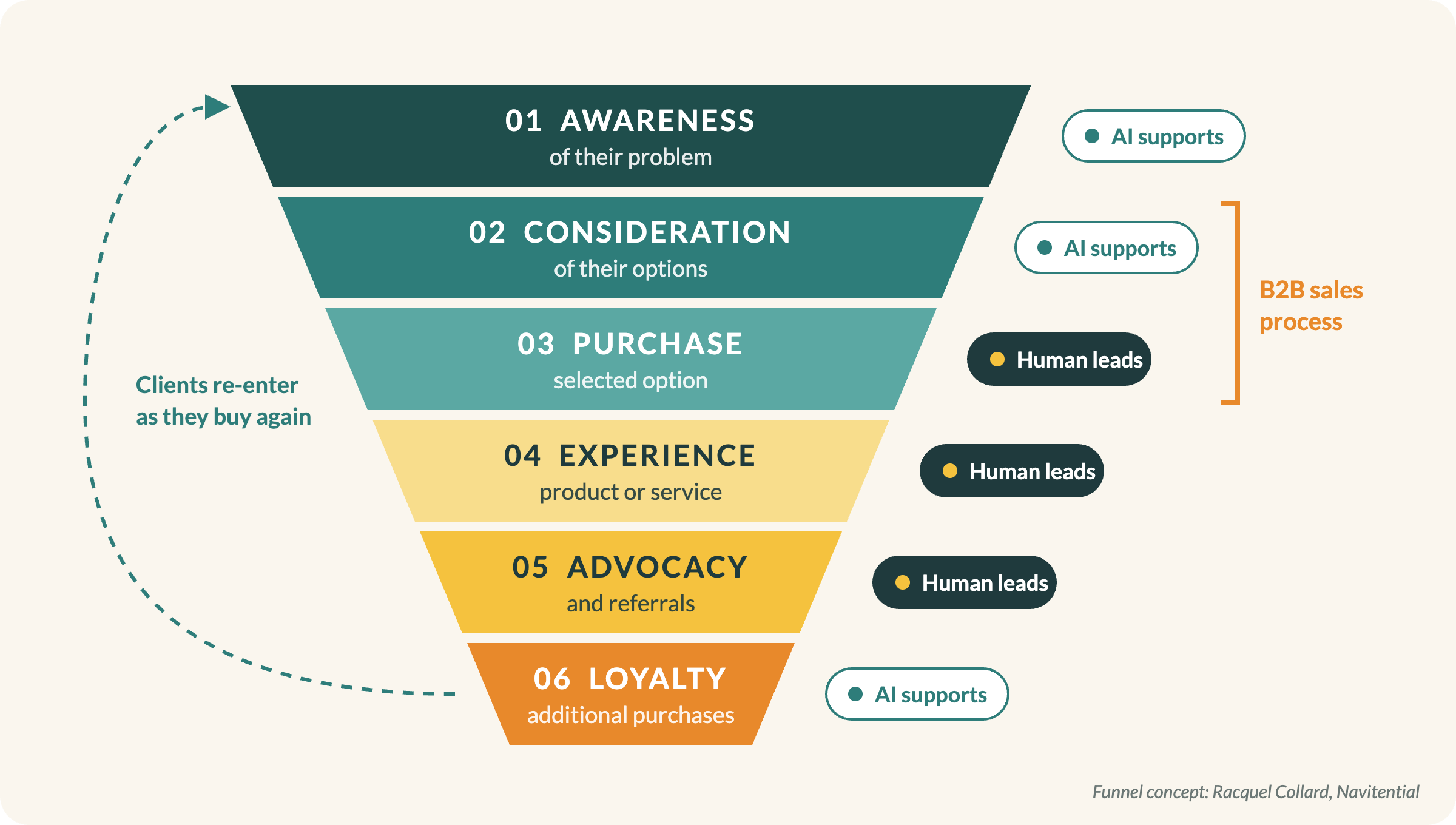
1.Awareness of their problem
2.Consideration of their options
3.Purchase of the option they've chosen
4.Experience of your product or service
5.Advocacy, which means telling others and referring you
6.Loyalty, which means making more purchases
Numbers drop as people move through the funnel, and that's okay. At every stage, people are testing whether your offer is a good fit for them. Some will decide it isn't, and that's healthy.
One-to-many, and one-to-one
Before we walk through the funnel, a quick reminder of the main difference between the two:
Marketing is one-to-many. You have one message and want it to reach a lot of the right people.
Sales is one-to-one. You're building a relationship with a particular person in a particular business.
Both matter at every stage of the funnel. What changes is which one is leading, and that depends on what you're selling.
For smaller, simpler sales, marketing can often take the customer most of the way. The follow-up emails, the nurture sequence, the offer and the checkout can all be one-to-many, and the customer is happy to buy without talking to anyone.
For larger B2B opportunities, it's a different story. The price is higher, the decision is more complex and there's more at stake. At some point, a person needs to pick up the follow-up and turn it into a conversation.
Awareness: marketing opens the door
At the top of the funnel, marketing does most of the work. Its job is to help the right people recognise the problem they have, and to make sure they come across you while they're thinking about it.
But sales has a role here too. Good salespeople don't leave prospecting entirely to marketing. They do their own targeted outreach and build their own pipeline.
Sales also brings something marketing can't get anywhere else: what customers actually say. The words they use to describe their problem and the objections they raise. When sales feeds that back, marketing's messaging gets much sharper.
AI supports here. It's brilliant for research, finding the right people, and turning one idea into ten pieces of content. This is one-to-many work, which is where automation does well.
Consideration: where the two overlap
This is where marketing and sales meet, and where the size of the sale really starts to matter.
Your prospect knows they have a problem and is weighing up their options. Marketing gives them something to engage with, like a webinar, a case study, a guide or an event. What happens next depends on the opportunity.
For a smaller sale, marketing can carry the follow-up. For example, someone attends your webinar and gets a well-crafted email sequence, a special offer and a clear way to buy. For a lower-priced product or service, that may be all they need.
For a larger B2B opportunity, that email is only the start. A good salesperson picks up the follow-up personally, perhaps mentioning the question that person asked during the session. At that point it becomes one-to-one. In B2B, this is where the sales process really begins.
This handover is where a lot of businesses drop the ball. They let marketing handle the follow-up on opportunities that really need a human, and the big deals quietly go cold. Leads are only worth something if the right person follows up with them.
AI supports here too. It can help you prepare for a call, research the prospect's business and draft a first-pass follow-up. But when a prospect with a bigger decision to make wants to talk through whether you're the right fit, that conversation belongs to a human.
Purchase: sales leads, marketing backs them up
For larger B2B opportunities, this stage is one-to-one. The decision is often a big one, with several people involved, a real budget, and someone's reputation on the line if it goes wrong.
Sales leads this stage. Buyers want to know who they'll be working with, ask the awkward questions and get a straight answer.
Marketing doesn't disappear, though. The best marketers listen to what's coming up in sales conversations and build the tools that help, such as a case study that answers a common objection, a clear one-pager for the buyer to share with their boss, or a proposal template that makes the offer easy to understand.
Human leads. Nobody wants to sign a six-figure contract with a chatbot.
Experience and Advocacy: the part everyone forgets
Once the deal is signed, a lot of businesses switch off both their marketing and their sales. That's a missed opportunity.
Experience is where you keep your promises: onboarding, delivery, and fixing things when they go wrong. The relationship that sales built needs to carry through into the work itself.
Advocacy is where it pays off. Happy clients become your best marketing. Here the two work together again:
Sales asks for the referral. Referrals are personal. People refer people they know, like and trust, and most happy clients are glad to help, but they won't think of it unless you ask.
Marketing captures the story. That becomes a testimonial, a case study or a LinkedIn post, which goes back to the top of the funnel to help the next prospect.
Human leads. An automated "leave us a review!" email won't get you a warm introduction to someone's biggest client. A genuine relationship will.
Loyalty: the funnel is really a loop
The funnel doesn't end at Loyalty. Your best clients come back around. They find a new problem, their business grows, or they move to a new company and take you with them. They go back into your funnel, and this time they're already warm.
Marketing keeps you front of mind with newsletters, updates and invitations to events. Sales keeps the relationship going with genuine check-ins and conversations about what's next for them.
AI supports here. It can flag who's due for a check-in, remind you what a client bought last time, and notice when an account has gone quiet. The conversation itself is still yours.
What makes marketing and sales work well together
Whether you have a whole team or you're a founder doing both jobs yourself, the same principles apply:
Work from the same picture. Both should understand the same funnel and the same ideal customer.
Keep the feedback flowing. Sales tells marketing what's coming up in conversations, and marketing builds tools to help.
Agree on the handover. Be clear about which opportunities marketing can carry through on its own, and which are big enough that a person needs to pick up the follow-up. Then agree what "ready for a conversation" looks like, so the big ones don't fall through the gap.
Don't rely on one to do the other's job. Marketing can't build one-to-one relationships at scale, and sales shouldn't sit waiting for marketing to hand over leads.
If you're a founder doing both, be deliberate about which hat you're wearing. Block time for one-to-many work and separate time for one-to-one conversations. Otherwise the urgent one will crowd out the important one.
Where AI fits
When you step back and look at the whole funnel, a pattern shows up:
AI handles the transactional. People handle the relational.
AI can support the stages that are mostly one-to-many: Awareness, Consideration and Loyalty. People need to lead where the relationship is built: Purchase, Experience and Advocacy.
The point of using AI well isn't to take humans out of the process. It's to free up more of your time for the conversations that really matter.
The bottom line
Marketing and sales aren't two separate departments passing leads over a wall. They're two halves of the same process, and they work best when they support each other the whole way through.
Buyers are still human (at least for now). They still buy from people they trust, stay with people who look after them, and refer people they like. Let marketing and AI open the door, then make sure a human is there to walk them through it.
Interested in learning more?
Join me and Racquel Collard from Navitential for our 4-part series as part of Small Business Month, starting 1st October. Join one session or all four.